6 Innovative 3D Printer Designs & Ideas For Advanced Makers
A 12-nozzle print head that would have seemed like science fiction five years ago just rolled across a CES show floor in January 2026, quietly making dual-extruder machines look like toys.[1] That single moment sums up where desktop fabrication stands right now: the gap between hobbyist gear and industrial-grade capability is closing faster than most makers can upgrade their toolchains. This roundup of 6 Innovative 3D Printer Designs & Ideas For Advanced Makers breaks down the machines and workflows actually worth tracking in 2026, from multi-material tool-changers to hybrid omni-printers that blur the line between 3D printing and textile production.
Disclosure: This post contains affiliate links. As an Amazon Associate, we earn from qualifying purchases, and at no extra cost to you.
Advanced makers no longer choose between speed, color, and material complexity. New architectures are delivering all three at once, and the designs below show exactly how that shift is happening on real hardware people can buy today.
Key Takeaways
* Multi-nozzle and tool-changer systems like AtomForm’s Palette 300 and Sovol’s M1D make true multi-material, multi-color printing realistic on a desktop budget.[1][3]
* Speed and intelligence gains are dramatic: CLIP resin systems run 25 to 100 times faster than older photopolymer methods, and multi-laser metal fusion delivers 200 to 400 percent more throughput.[2]
* Hybrid “omni” machines such as xTool’s O1 Omni Printer combine UV, DTG, DTF, and embroidery workflows in one desktop chassis, expanding what a single rig can produce.[15]
* Large-format and modular systems, including the Kentstrapper Mille System and Prusa INDX, are pushing near-industrial build volumes into small workshop budgets.[13]
* Accessory innovation, like filament dryers and external filtration units, is becoming essential infrastructure for advanced, high-reliability printing setups.[11]
Why 2026 Is a Turning Point for Advanced 3D Printing
Four forces are reshaping what counts as a serious desktop printer this year: speed, intelligence, materials, and standards.[2] Continuous liquid interface production, or CLIP, resin systems now run 25 to 100 times faster than earlier photopolymer methods, while multi-laser metal powder bed fusion machines using four to twelve lasers are posting throughput gains of 200 to 400 percent over single-laser designs.[2] On the software side, AI-driven generative design is producing parts that are 30 to 70 percent lighter than solid equivalents, and real-time AI defect detection is now catching print failures at the individual layer level on industrial machines.[2]
These aren’t abstract industrial statistics anymore. They are trickling directly into consumer and prosumer hardware. Consumer-level printers are already reaching speeds up to 1000 mm/s, roughly ten times faster than typical 2020-era machines, and AI-powered slicing is largely eliminating the manual parameter tuning that used to eat up hours of setup time.[7] Hybrid devices that combine 3D printing with laser engraving or CNC-style operations in a single chassis are also becoming more common, letting small shops offer rapid custom manufacturing without buying three separate machines.[7][8]
Metal printing is following a similar trajectory. Cold Metal Fusion, which blends powder coating techniques with sintering, is making metal part production more accessible outside of aerospace-grade facilities, and multi-material metal printing is edging toward small-scale prosumer studios rather than staying locked in industrial-only environments.[8] Analysts describe these as bridge technologies that could gradually shift high-end metal fabrication into serious maker spaces over the next few years.[8]
None of this happens in a vacuum. Slicer software from Cura, PrusaSlicer, and Bambu Studio has been updated throughout 2026 to improve multi-material support and print quality algorithms, while automated bed leveling and AI-powered error detection are becoming standard features on hobbyist machines.[10] The result is a lower learning curve for beginners paired with far more control for advanced users who care about strength, anisotropy, and surface finish.[5][7][10] That combination sets the stage for the six standout systems below.
6 Innovative 3D Printer Designs & Ideas For Advanced Makers
Each entry here represents a distinct design philosophy rather than a single product category. Together, they map out the real options advanced makers are weighing in 2026, whether the goal is multi-material complexity, metal fabrication, hybrid textile work, or sheer build volume.
1. AtomForm Palette 300: The 12-Nozzle Multi-Material FDM System
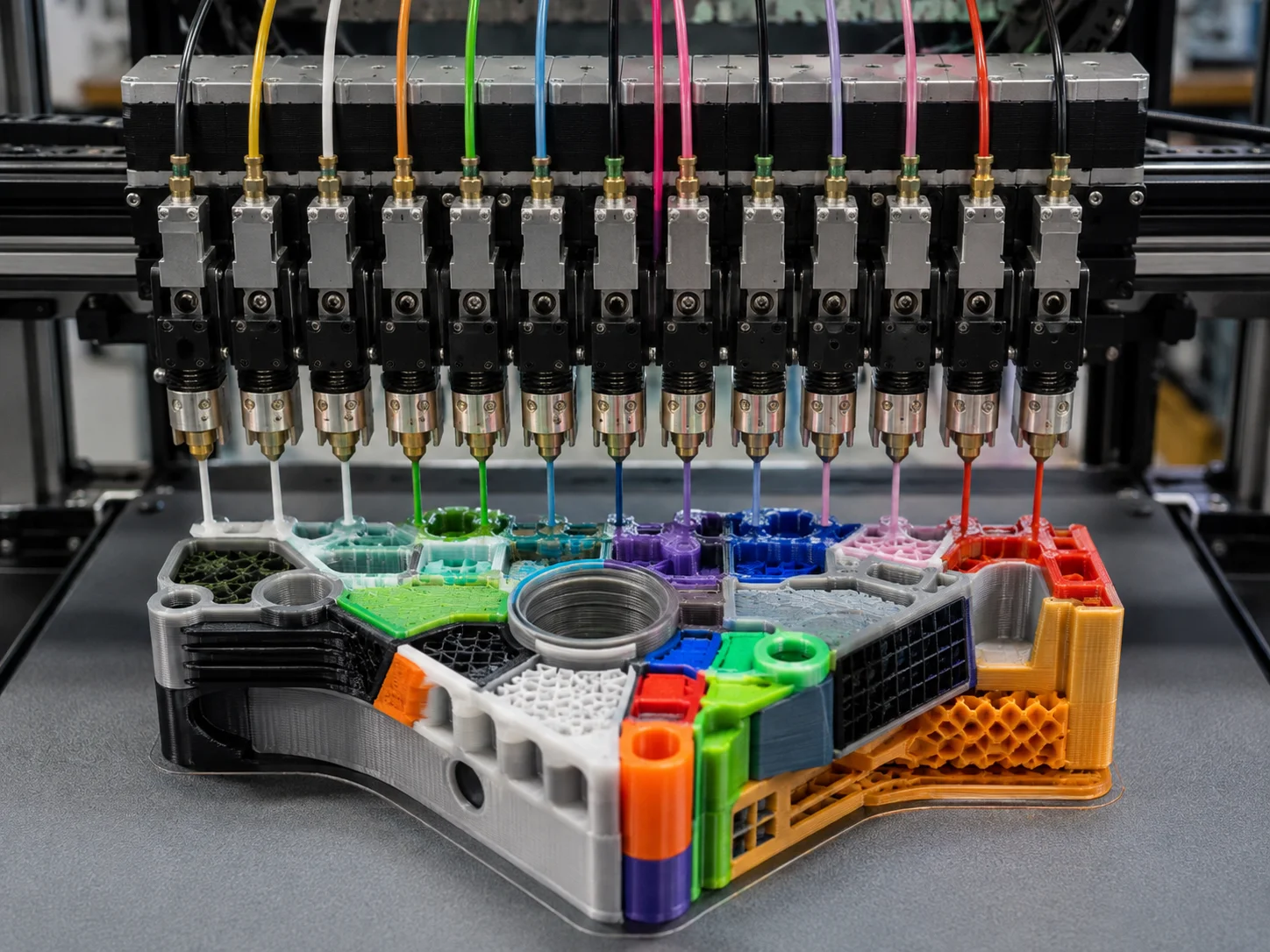
The Palette 300 made headlines at CES 2026 for a reason: it uses twelve independently controlled nozzles to build complex, multi-material parts that were simply impossible on conventional dual-extruder machines.[1] Instead of pausing a print to swap filament or relying on a single nozzle to purge and reload different materials, this design lets each nozzle specialize, cutting down on waste and dramatically expanding the range of geometries and material combinations in a single job.
For advanced makers, the appeal is obvious. Projects that once required assembling multiple printed components from separate machines can now be produced as one continuous build. This matters most for functional prototypes that combine rigid structural sections with flexible or conductive elements, where material transitions used to be the weak point of the whole design.
2. Ohsung Gauss MT90: Compact Metal Paste Printing for Desktops
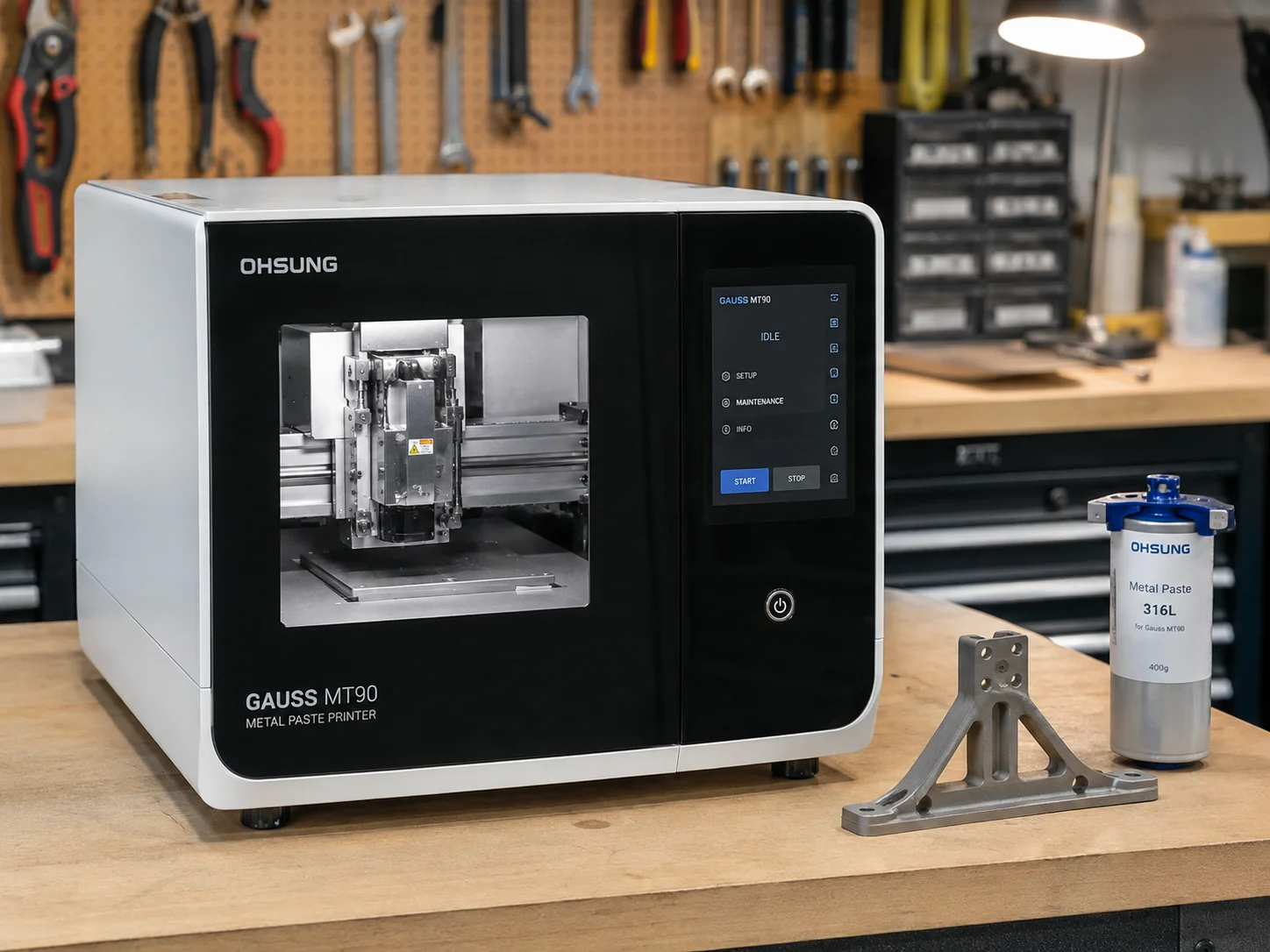
Desktop metal printing has been a promise for years, and the Gauss MT90 is one of the clearest signs that promise is becoming reality.[1] Rather than using powder bed fusion, which typically requires industrial safety infrastructure, the MT90 works with metal paste, allowing it to fit on a workshop bench while still producing genuine metal parts.
This approach lines up with the broader Cold Metal Fusion trend, where powder coating and sintering techniques are combined to make metal part production more approachable outside dedicated industrial facilities.[8] For makers who need small metal brackets, tooling inserts, or functional prototypes without outsourcing to a machine shop, compact metal paste systems like this one represent a genuinely new capability tier.
“Desktop metal and playful smart hardware are converging for prosumer use,” according to CES 2026 coverage, capturing how quickly formerly industrial-only capabilities are reaching maker-scale machines.[1]
3. Sovol M1D: IDEX Plus Tool-Changer for Seven-Color Workflows
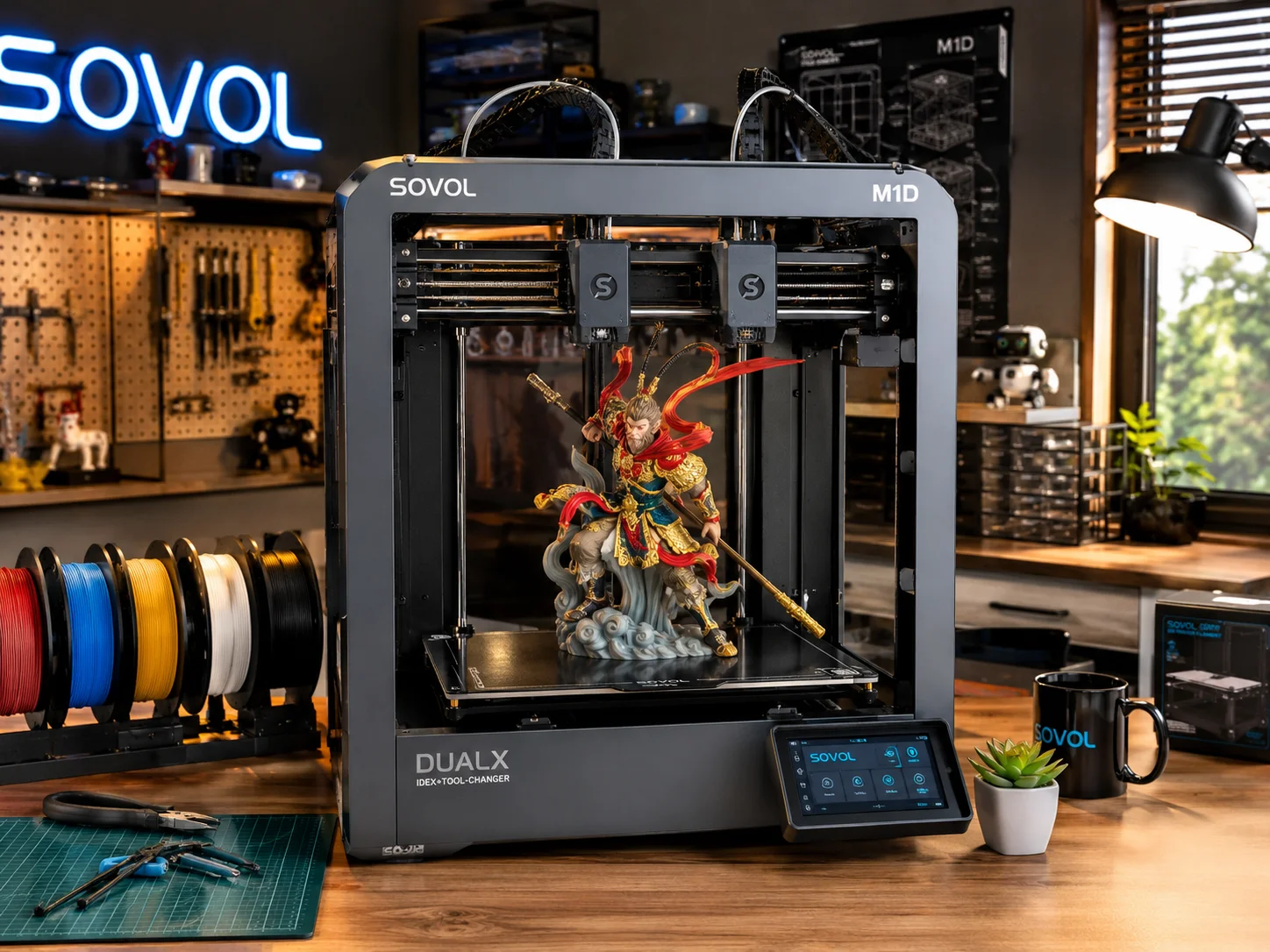
Announced July 24, 2026, the Sovol M1D stands out as one of the most advanced desktop multi-color platforms built for serious hobbyists and small workshops.[3] It offers a 300 by 300 by 350 millimeter build volume paired with a DualX system that merges Independent Dual Extruders, known as IDEX, with a tool-changer mechanism. That combination lets the machine handle up to seven colors and materials within a single print job.[3]
The M1D’s design choices reflect what advanced users actually ask for. It uses all-metal extruders with hardened steel nozzles, which means it can handle high-temperature engineering filaments without the nozzle wear that plagues brass alternatives.[3] It also ships with open-source, Klipper-based firmware configurations, giving experienced makers direct access to tune motion planning, temperature curves, and multi-material sequencing rather than being locked into a closed ecosystem.[3] That openness is a major reason the machine is being positioned as a customizable workhorse rather than a plug-and-play consumer toy.
4. xTool O1 Omni Printer: A Hybrid Multi-Process Maker Studio
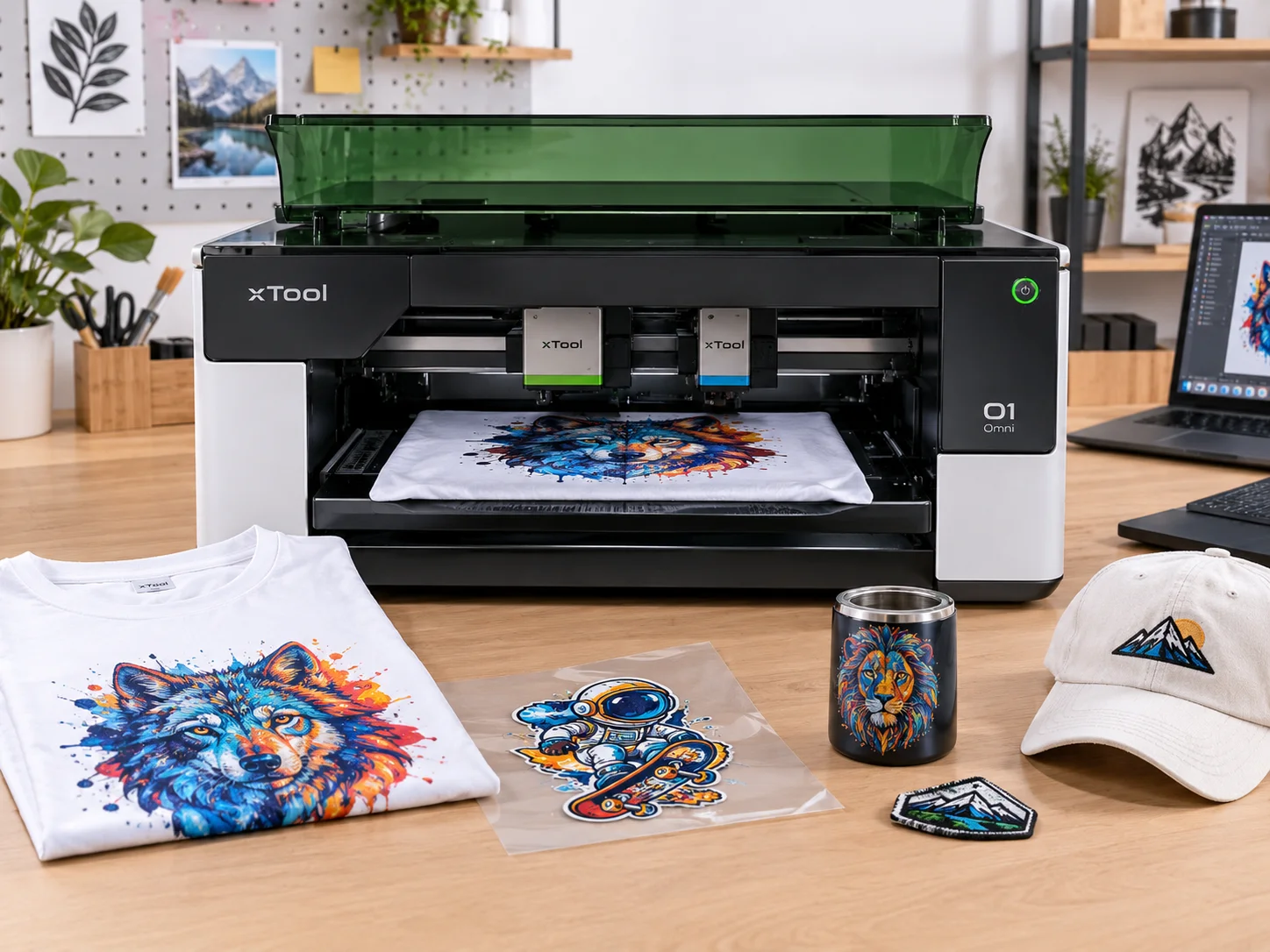
Officially launched globally on July 16, 2026, the xTool O1 Omni Printer introduces a genuinely new hardware category by merging UV printing, direct-to-garment printing, direct-to-film printing, and UV-DTF printing into one dual-printhead desktop platform.[15] It goes a step further by adding a desktop 3D embroidery workflow, something that has traditionally required a completely separate machine and skill set.[15]
The O1 Omni is offered in three configurations, with early-bird pricing ranging from $1,699 to $2,799 against an MSRP of $2,499 to $3,499.[15] For advanced makers running a small studio or side business, this kind of price range matters less as an isolated number and more as a signal: multi-process machines that used to require several separate rigs, and several separate budgets, are consolidating into single desktop platforms. That consolidation is exactly why omni-style printers deserve serious consideration among 6 Innovative 3D Printer Designs & Ideas For Advanced Makers, since they change studio economics as much as they change what can physically be produced.
5. Seven-Channel Resin Systems for Functional Multi-Material Devices
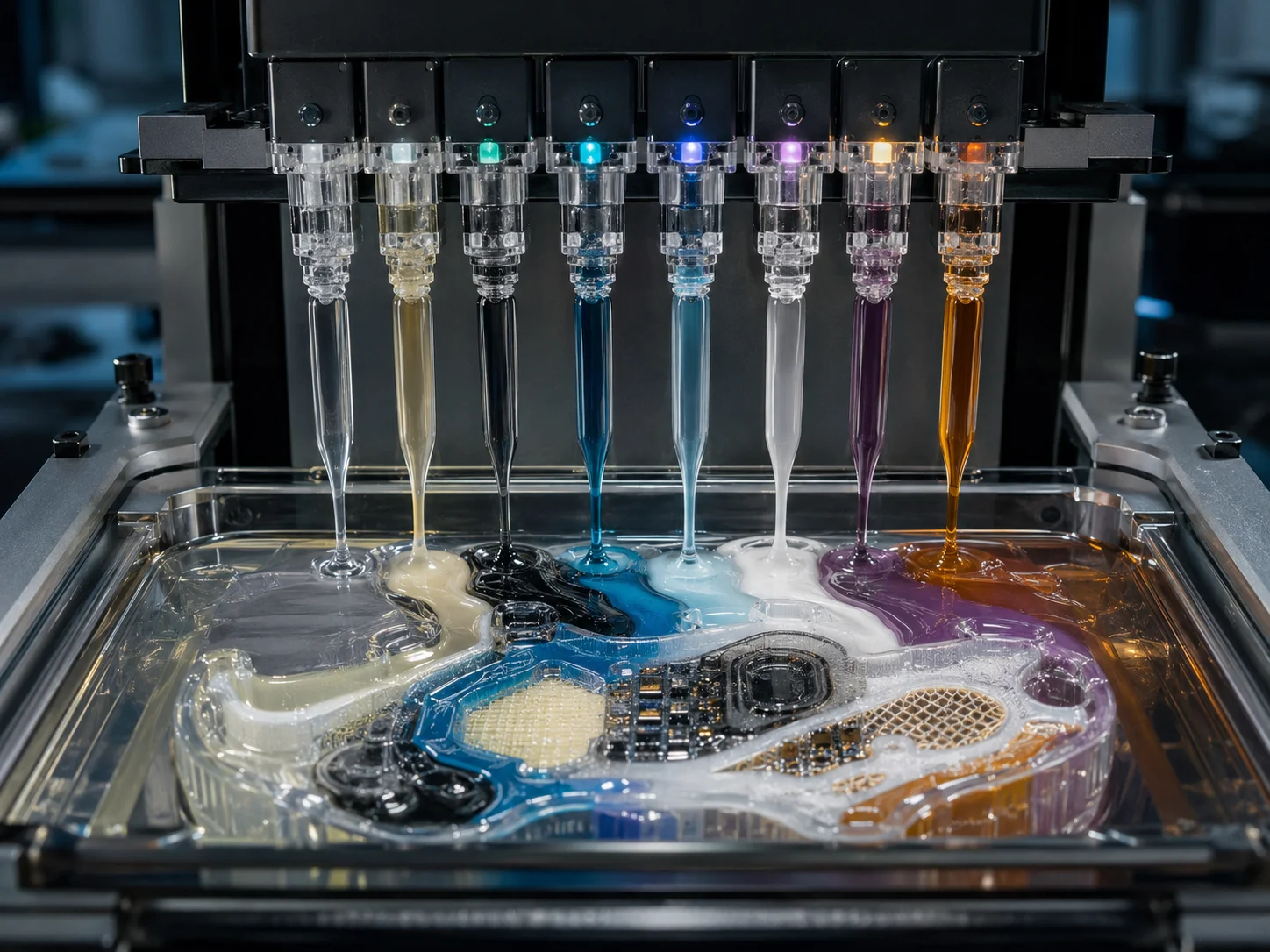
Late-2025 and 2026 previews of next-generation resin printers describe an architecture built around seven-channel resin delivery, which allows a single machine to print elastomers, rigid polymers, transparent materials, biocompatible resins, and conductive inks simultaneously.[6] This is a meaningful departure from typical desktop resin printing, where a single vat and a single material dominate the entire build.
Analysts view this multi-channel approach as an important direction for advanced experimental makers and research labs, because it enables fabrication of complex functional devices, think sensors embedded in flexible housings, or optical components paired with rigid mounting structures, within one build rather than assembling multiple separately printed parts afterward.[6] Combined with CLIP resin systems running 25 to 100 times faster than older photopolymer methods, this points toward a future where high-complexity resin prints no longer come with the speed penalty that has historically limited their use in iterative prototyping.[2][6]
6. Modular Large-Format Systems: Kentstrapper Mille and Prusa INDX
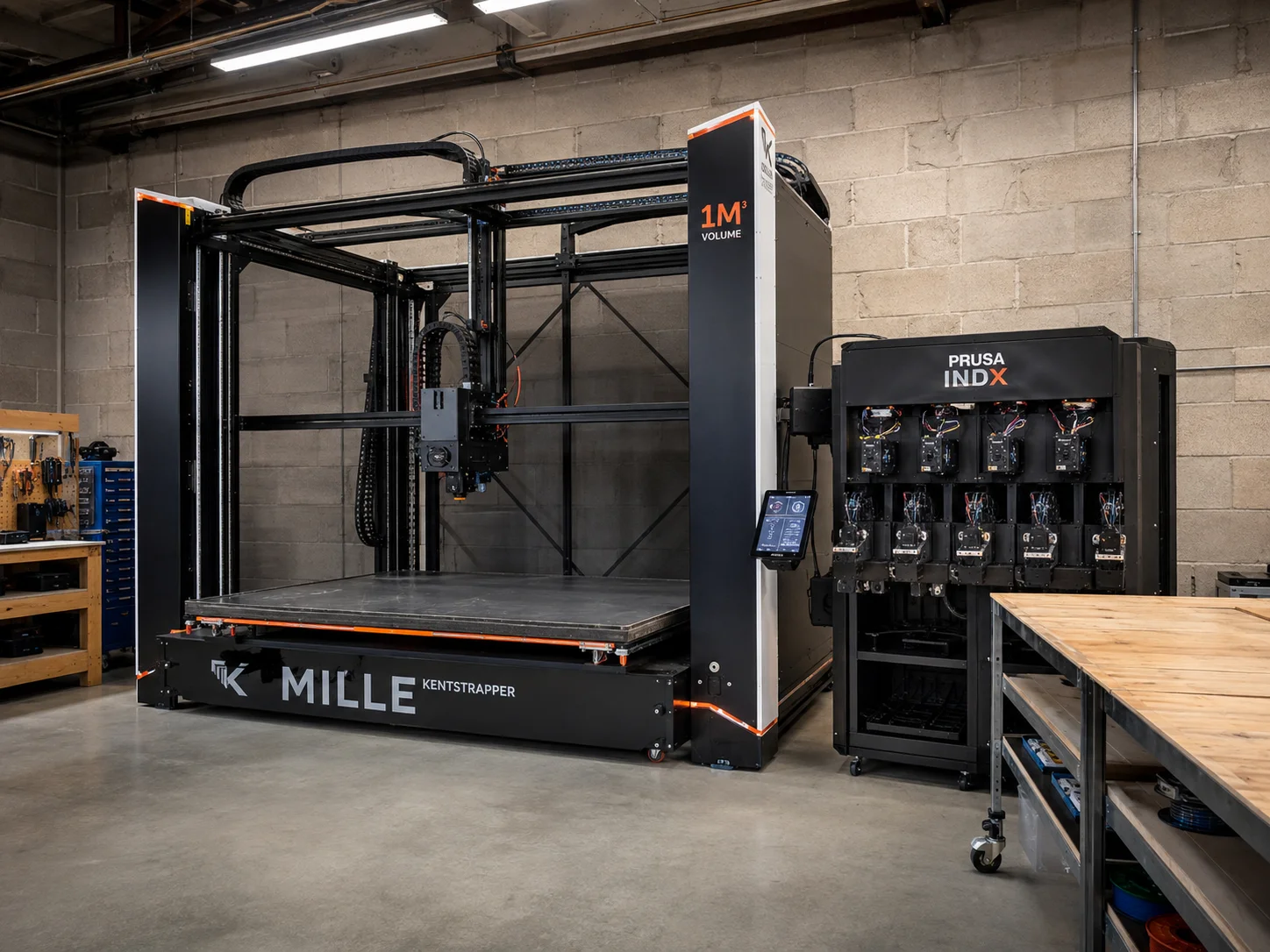
Not every advanced maker needs more colors or more materials. Some need more space, and 2026 has delivered on that front too. The Kentstrapper Mille System, launched this year, offers roughly a one cubic meter build volume for around 40,000 euros, a price point that makes industrial-scale FDM printing genuinely attainable for small businesses rather than only large manufacturers.[13]
Alongside it, the Prusa INDX platform uses a modular tool-changing system that reflects a broader industry move toward configurable print farms and multi-head rigs tailored to different materials and tasks.[13][10] Rather than buying a single-purpose machine, makers running these systems can reconfigure toolheads for different jobs, extending the useful life of the hardware and reducing the number of machines needed to cover a growing range of client requests.
How These Designs Compare: A Quick Reference Table
The table below summarizes the core differentiator behind each of the 6 Innovative 3D Printer Designs & Ideas For Advanced Makers covered above, making it easier to match a design philosophy to a specific workflow need.
| Design | Core Innovation | Best Suited For |
|---|---|---|
| AtomForm Palette 300 | 12-nozzle multi-material FDM head | Complex functional prototypes needing many material transitions |
| Ohsung Gauss MT90 | Compact desktop metal paste printing | Small metal brackets and tooling without industrial infrastructure |
| Sovol M1D | IDEX plus tool-changer for 7 colors/materials | Multi-color figures and high-temperature engineering filaments |
| xTool O1 Omni Printer | Hybrid UV, DTG, DTF, and embroidery platform | Small studios producing apparel, decals, and mixed-media goods |
| Seven-channel resin systems | Simultaneous multi-resin functional printing | Research labs and experimental device prototyping |
| Kentstrapper Mille / Prusa INDX | Modular large-format and tool-changing FDM | Small businesses needing industrial-scale, configurable output |
This kind of side-by-side view matters because advanced makers rarely need every capability at once. Matching the design to the actual production bottleneck, whether that is color complexity, material diversity, or sheer part size, tends to produce a much better return on investment than chasing the flashiest spec sheet.
Supporting Trends Shaping These Designs
A few surrounding developments help explain why these six designs are emerging now rather than years earlier.
Color and material accessibility have expanded rapidly. Consumer-oriented innovations now claim automatic printing in nineteen or more colors, and full-color desktop machines such as Flashforge’s CJ270 are being marketed as the world’s first desktop full-color 3D printer.[7][9] Trend analysts argue that these systems, paired with AI-assisted slicing and smarter firmware, are pushing color-accurate figurines, custom enclosures, and design prototypes firmly into mainstream maker workflows rather than keeping them as industrial specialties.[7][9][10]
Accessory infrastructure has matured alongside the printers themselves. Component-focused coverage from mid-2026 highlights ELEGOO’s H1 HT filament dryer, launched July 24, 2026 at around $70, and Mintion’s external Filtration System V1, designed to reduce particles and volatile organic compounds released by desktop printers.[11] These are not optional extras for advanced users working with hygroscopic engineering filaments or running printers indoors for long stretches. They are becoming standard infrastructure that keeps high-performance machines reliable and safer to operate.[11]
Finally, the maker community itself is pushing boundaries beyond stock hardware. Coverage of the August 2026 Open Sauce event documented wild custom builds, including 3D-printed printers, desktop UV machines, full-color printers priced around $1,700, flash-cured resin setups, and even rideable 3D-printed speeder bikes.[14] This grassroots experimentation matters because it shows advanced makers are not just adopting new commercial designs, they are actively modifying and combining them into entirely new categories of hardware for artistic, robotic, and transport projects.[14]
Frequently Asked Questions About 6 Innovative 3D Printer Designs & Ideas For Advanced Makers
Are multi-nozzle and tool-changer printers worth the extra cost for hobbyists?
For makers regularly producing multi-color or multi-material parts, yes. Systems like the Sovol M1D reduce the manual filament swapping and post-processing that eat up hours on single-extruder machines, and the time saved often outweighs the higher upfront price for anyone running frequent projects.[3]
Is desktop metal printing actually practical for small workshops yet?
It is becoming more practical every year. Compact metal paste systems like the Gauss MT90, combined with Cold Metal Fusion techniques that blend powder coating and sintering, are lowering the infrastructure requirements that used to make metal printing an industrial-only capability.[1][8]
Do hybrid omni-printers replace dedicated 3D printers entirely?
Not entirely. Machines like the xTool O1 Omni Printer are built around UV, DTG, DTF, and embroidery workflows rather than traditional layer-by-layer FDM or resin printing, so they complement a maker’s existing 3D printer rather than replacing it outright.[15]
How much faster are the newest resin and metal systems compared to older machines?
CLIP resin systems now run 25 to 100 times faster than earlier photopolymer methods, and multi-laser metal powder bed fusion machines with four to twelve lasers are delivering 200 to 400 percent higher throughput than single-laser designs.[2]
What accessories should advanced makers prioritize alongside a new printer?
Filament drying and air filtration are two of the most commonly overlooked upgrades. Products like ELEGOO’s H1 HT dryer and Mintion’s Filtration System V1 directly address filament degradation and indoor air quality, both of which affect print reliability and long-term health.[11]
Conclusion
The six designs covered here, from AtomForm’s 12-nozzle Palette 300 to modular large-format systems like the Kentstrapper Mille, all point toward the same conclusion: advanced makers no longer have to accept trade-offs between speed, material complexity, and build size. Each of these 6 Innovative 3D Printer Designs & Ideas For Advanced Makers solves a specific bottleneck that used to require compromise, whether that meant limiting color count, avoiding metal parts, or splitting a project across multiple machines.
The practical next step is straightforward. Identify which bottleneck actually limits current projects, whether it is color and material variety, metal fabrication, hybrid textile work, functional multi-resin prototyping, or sheer build volume, and then match that bottleneck to the design category above rather than chasing every new feature at once. Pair any new hardware investment with the supporting infrastructure, proper filament drying, adequate filtration, and updated slicer software, since these often determine whether an advanced printer performs at its rated capability or falls short in daily use.[10][11] Makers who treat 2026’s design shift as a toolkit to select from, rather than a single machine to chase, will get the most value from this wave of innovation.
References
[1] 3d Printing Innovations Ces 2026 14012026 – https://www.3dnatives.com/en/3d-printing-innovations-ces-2026-14012026/
[2] Top 10 3d Printing Innovations To Watch – https://www.aoseed.com/blogs/aoseed-sale/top-10-3d-printing-innovations-to-watch
[3] Sovol Introduces M1d Combining Multi 141500330 – https://finance.yahoo.com/technology/articles/sovol-introduces-m1d-combining-multi-141500330.html
[5] Watch – https://www.youtube.com/watch?v=2mpPjOtq5wM
[6] Top 5 Next Generation 3d Printers Of 2026 Ultra Speed Ai Driven Calibration Multi Material Fusion And Industrial Additive Breakthroughs – https://cnccode.com/2025/11/24/top-5-next-generation-3d-printers-of-2026-ultra-speed-ai-driven-calibration-multi-material-fusion-and-industrial-additive-breakthroughs/
[7] 3d Printing Innovations – https://3dprintingideas.com/3d-printing-innovations/
[8] Latest 3d Printing Innovations 2026 – https://shop.ugee.com/blogs/news/latest-3d-printing-innovations-2026
[9] Cool New Gadgets 3d Printing 2026 – https://www.bgr.com/2116355/cool-new-gadgets-3d-printing-2026/
[10] 3d Printing 2026 07 25 – https://shamylmansoor.com/blog/3d-printing-2026-07-25/
[11] New 3d Printing Gadgets In 2026 – https://www.slashgear.com/2135782/new-3d-printing-gadgets-in-2026/