Smart Home Aesthetic: 8 Ways to Make Your Automation Beautiful
More than 70 percent of homeowners who invest in smart home technology later report dissatisfaction, not with the performance of their devices, but with how those devices look inside their homes. Wires, chunky hubs, glowing LED indicators, and mismatched wall panels quietly undermine the interior design that cost thousands of dollars to achieve. The good news is that the industry has reached a turning point. The Smart Home Aesthetic: 8 Ways to Make Your Automation Beautiful framework emerging across design studios and trade fairs in 2026 treats automation hardware as a finish material, not an afterthought, and the results are transforming how homes feel as much as how they function [1][3].
Disclosure: This post contains affiliate links. As an Amazon Associate, we earn from qualifying purchases, and at no extra cost to you.
Key Takeaways
- Invisible, design-first integration is now the dominant philosophy in smart home planning, replacing feature-heavy gadget stacking.
- Tunable, layered lighting is the single highest-impact aesthetic upgrade available in any automated home.
- Hardware finishes, control surfaces, and sensor housings should be selected with the same rigor as flooring or cabinetry materials.
- Scene-based automation is a powerful aesthetic tool, not just a convenience feature, that shapes the mood and visual identity of every room.
- Interior designers and AV professionals are converging on a single design agenda: automation planned at the layout stage delivers far better aesthetic outcomes than retrofitting later.
Why Aesthetic-First Smart Home Design Is Now the Standard
For most of the past decade, smart home technology was sold on capability. Could it turn off the lights from your phone? Could it lock the door remotely? Those questions dominated purchasing decisions, while the visual impact of the hardware was treated as irrelevant. That era is ending.
Trade events such as the Smart Home IoT Expo 2026 in Warsaw, billed as an international fair for interior and residential building automation, show a clear convergence of AV technology, IoT hardware, and interior design under a single aesthetic agenda [8]. Manufacturers are launching products in brushed brass, matte black, warm white, and natural stone finishes. Interior designers are specifying automation systems during the layout stage, not after the walls are painted [6]. The industry consensus has shifted from feature-rich to design-first product selection [10].
This shift matters because the home is no longer just a functional space. It is a curated environment. When technology disrupts that curation, it creates visual noise that undermines well-being and resale value alike. The Smart Home Aesthetic: 8 Ways to Make Your Automation Beautiful approach addresses each source of that visual noise systematically.
“The best smart home technology is the kind you never notice, until you need it.”
The 8 Ways to Make Your Smart Home Automation Beautiful
1. Embrace the “Invisible Tech” Philosophy
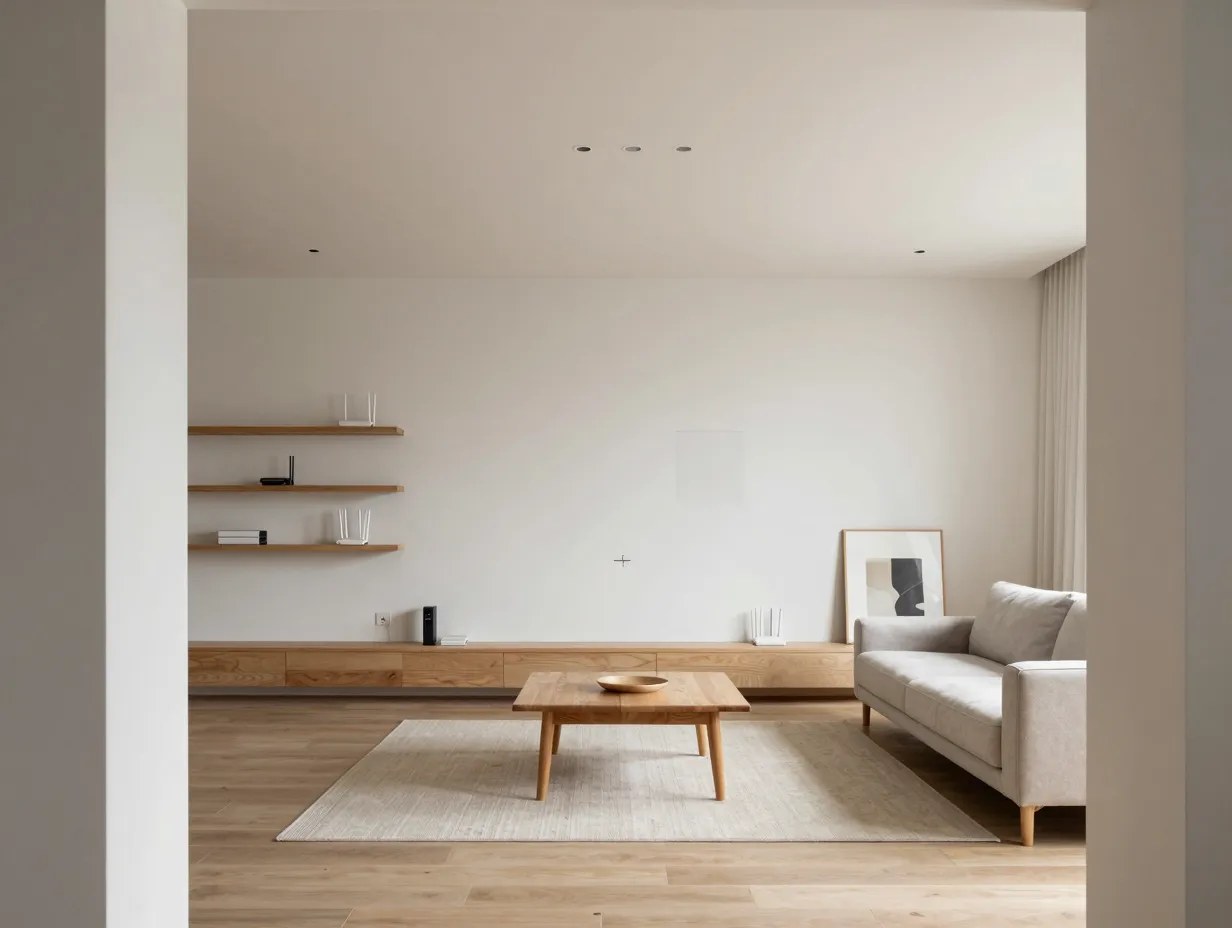
The most powerful design principle in modern smart home aesthetics is subtraction. Every device that can be hidden, recessed, or eliminated from the visual field should be. This “invisible tech” philosophy does not mean abandoning capability, it means relocating it [9].
Routers belong in closets. Hubs belong behind panels. Motion sensors belong inside ceiling recesses or disguised as architectural details. When technology disappears from view, the room’s original design language reasserts itself. The automation serves the space rather than competing with it.
Practical steps to apply this principle:
- Audit every visible device in each room and categorize it as “must-be-visible,” “can-be-relocated,” or “can-be-concealed.”
- Use in-wall cable management systems to eliminate surface-run wires entirely.
- Choose wireless protocols (Z-Wave, Zigbee, Thread/Matter) that reduce the need for wired infrastructure visible to occupants.
- Install equipment closets or dedicated AV panels during renovation rather than retrofitting.
Homes designed around invisible tech feel calmer, more spacious, and more intentional, qualities that translate directly into higher perceived value [2].
2. Treat Hardware as a Finish Material
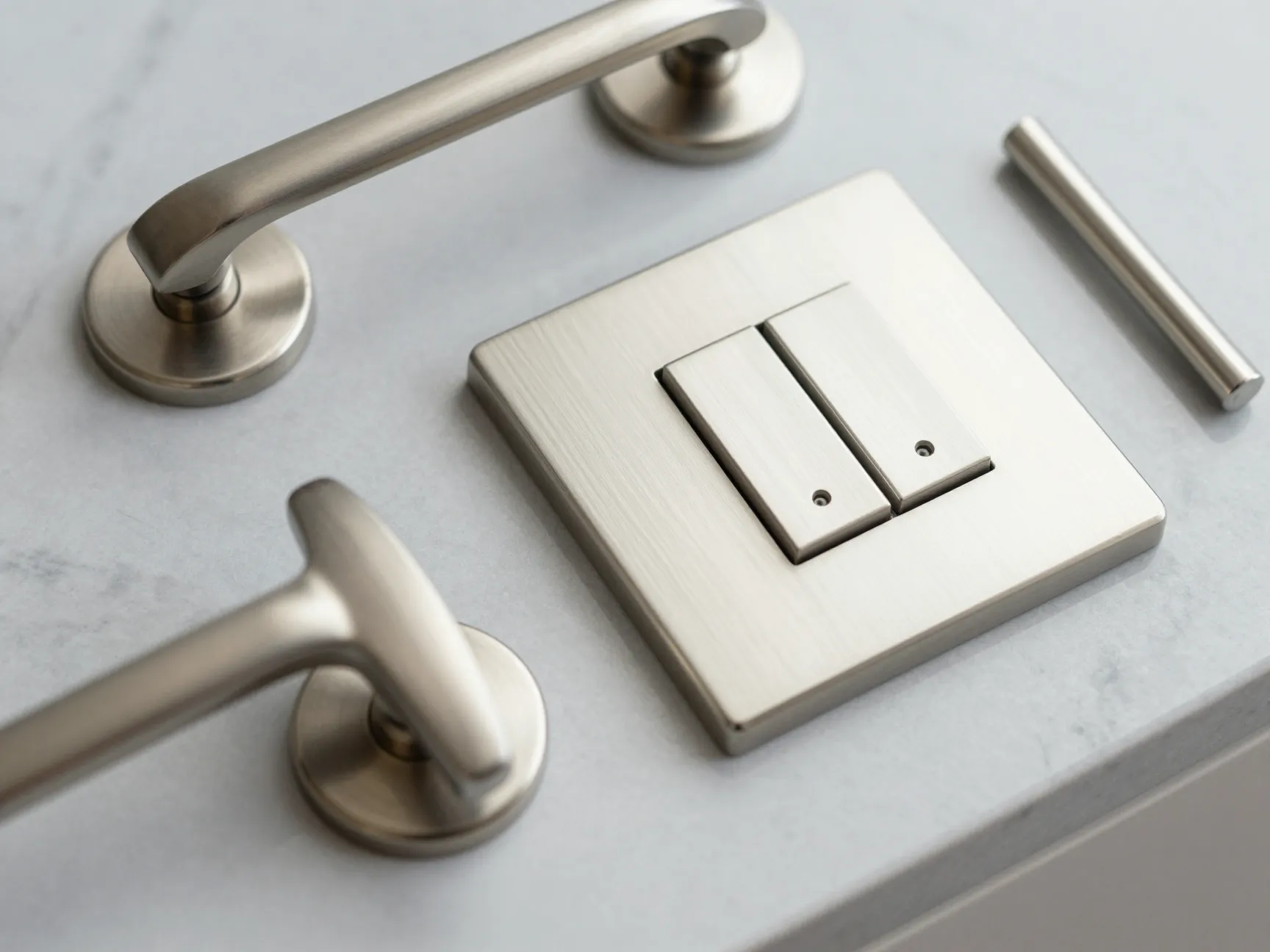
A light switch is not just a functional object. In a well-designed room, it is a piece of hardware that should coordinate with door handles, cabinet pulls, and plumbing fixtures. The same logic applies to every smart device in the home [3].
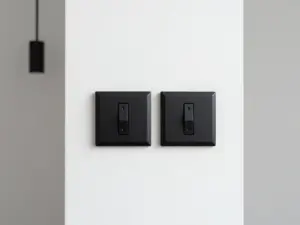
Leading manufacturers now offer smart switches, dimmers, and keypads in finishes that match standard architectural hardware lines: polished nickel, antique bronze, satin brass, matte black, and warm white. When a smart keypad shares its finish language with the door hardware two feet away, the technology stops reading as an intrusion and starts reading as part of the room.
This principle extends beyond switches. Smart thermostats, intercom panels, and even sensor housings are now available in premium finishes from brands positioning themselves at the intersection of technology and design [6]. The investment is modest compared to the visual return.
3. Layer and Tune Your Lighting for Maximum Visual Impact
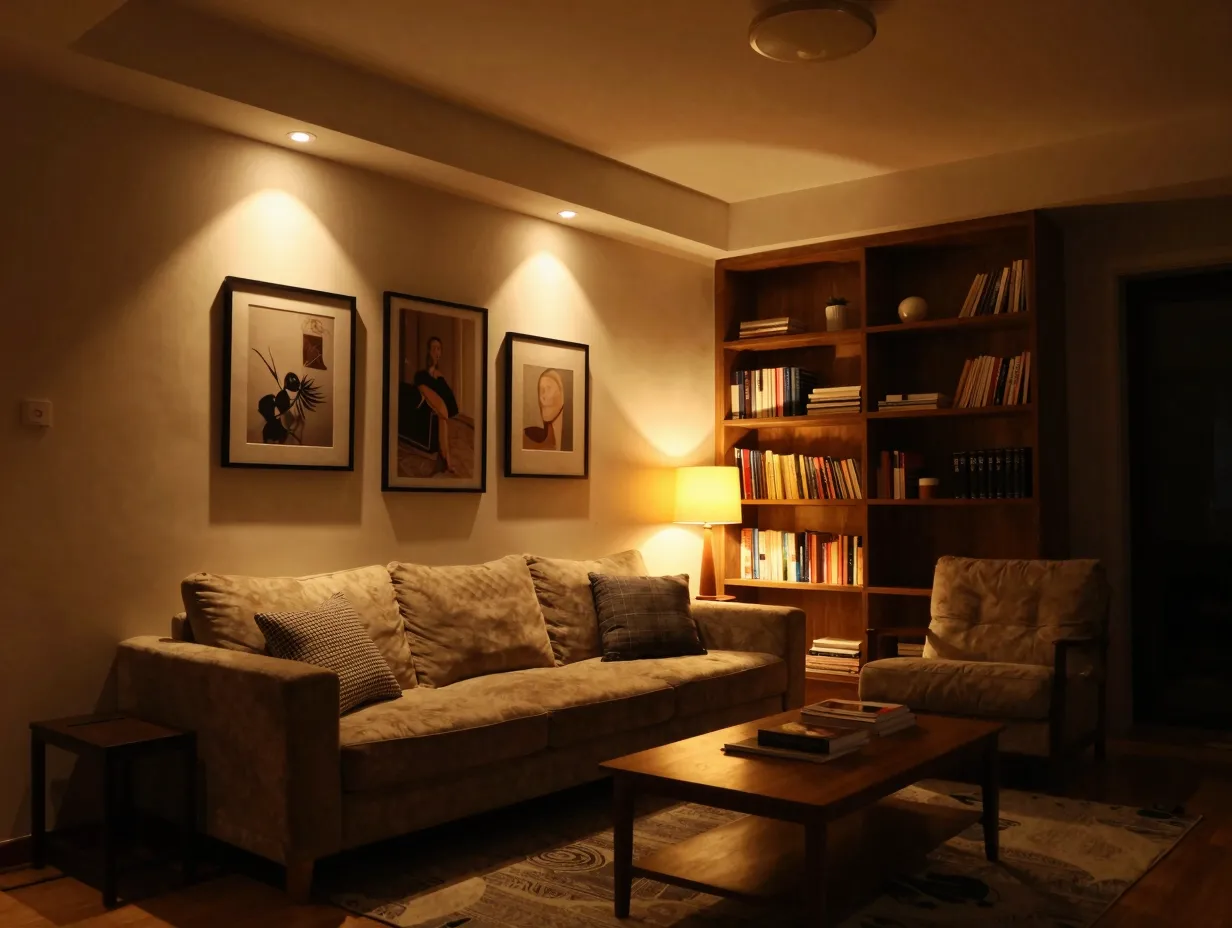
Of all the tools available in the Smart Home Aesthetic: 8 Ways to Make Your Automation Beautiful toolkit, tunable, layered lighting delivers the greatest return on investment. Lighting does not merely illuminate a space, it defines its character, its warmth, and its perceived dimensions [4].
Layered lighting means combining three distinct types in every room:
| Layer | Type | Purpose |
|---|---|---|
| Ambient | Recessed downlights, cove lighting | General illumination, sets overall mood |
| Task | Under-cabinet, desk, reading lamps | Functional focus lighting |
| Accent | Picture lights, shelf lighting, toe-kick | Highlights architecture and objects |
Smart tunable white lighting allows color temperature to shift across the day, from energizing cool white (5000K) in the morning to warm amber (2700K) in the evening. This circadian-aligned approach improves both well-being and the visual quality of the space at every hour [4].
Key specification decisions:
- Choose fixtures with a Color Rendering Index (CRI) of 90 or higher for accurate, flattering color rendering.
- Specify warm-dimming LED sources that shift toward amber as they dim, mimicking incandescent behavior.
- Program lighting scenes that correspond to activities, not just “on” and “off.”
The result is a home that looks professionally lit at every moment of the day, without manual adjustment.
4. Integrate Smart Shades Into the Visual Composition
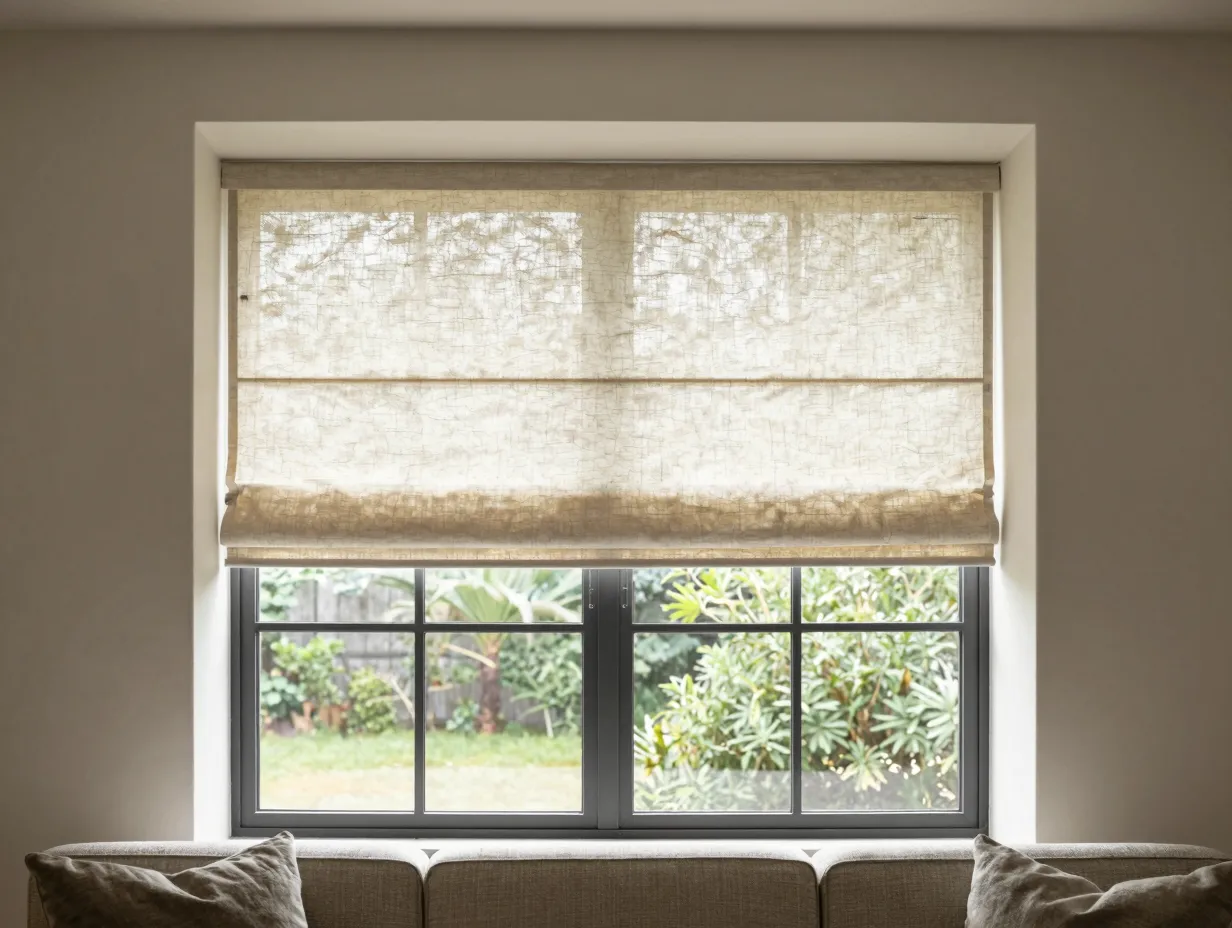
Window treatments are among the most architecturally significant elements in any room. They define proportions, control natural light, and anchor the wall plane. Smart motorized shades elevate this role by making the window treatment an active participant in the room’s aesthetic performance [5].
Linen, woven wood, and solar screen fabrics in motorized systems offer the same material quality as manual treatments, while adding precision light control. When programmed to rise and fall with the sun’s position, they become part of a living visual composition, one that changes throughout the day in a way that feels organic rather than mechanical.
Aesthetic integration tips:
- Specify recessed pockets above windows to conceal rolled shades completely when open, preserving clean sight lines.
- Coordinate shade fabric color and texture with upholstery and wall finishes.
- Use top-down/bottom-up configurations to allow natural light entry while maintaining privacy at eye level.
- Program shades to respond to lighting scenes, when the “evening” scene activates, shades descend automatically.
This integration between motorized shades and lighting scenes is one of the clearest demonstrations that automation, when designed well, enhances rather than disrupts interior aesthetics [7].
5. Minimize, Relocate, or Conceal Control Surfaces
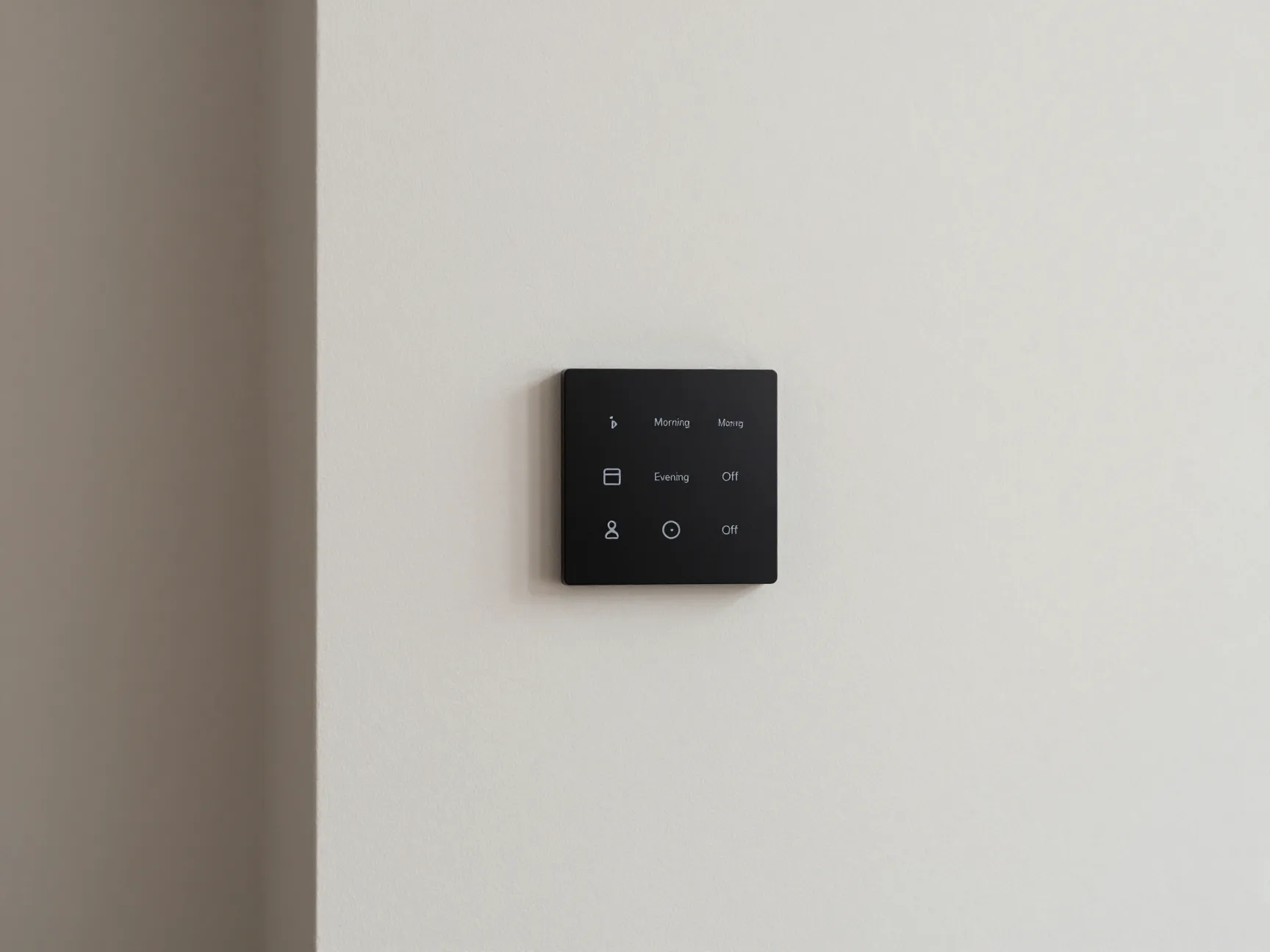
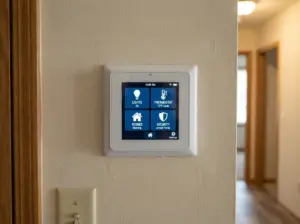
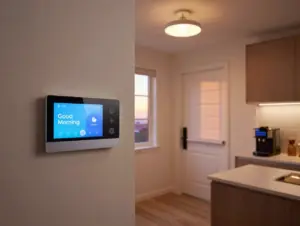
The wall-mounted touchscreen that seemed impressive in a showroom often becomes a visual liability in a finished room. Control surfaces, keypads, touchscreens, voice assistant devices, represent the most visible intrusion of technology into domestic space, and they deserve the most deliberate design attention [3].
The current best practice is a hierarchy of control that minimizes visible hardware:
- Automation first, program the home to anticipate needs without requiring any input.
- Voice control second, use compact, architecturally neutral voice devices only where automation cannot predict behavior.
- App control third, smartphones replace dedicated wall-mounted touchscreens in most residential applications.
- Physical keypads last, where physical controls are necessary, specify slim, finish-matched keypads with engraved scene labels rather than generic toggle switches.
Removing unnecessary control surfaces from walls is one of the fastest ways to improve the aesthetic quality of a smart home. Every device removed is a visual distraction eliminated [9].
6. Select Hubs and Sensors for Their Aesthetic Form
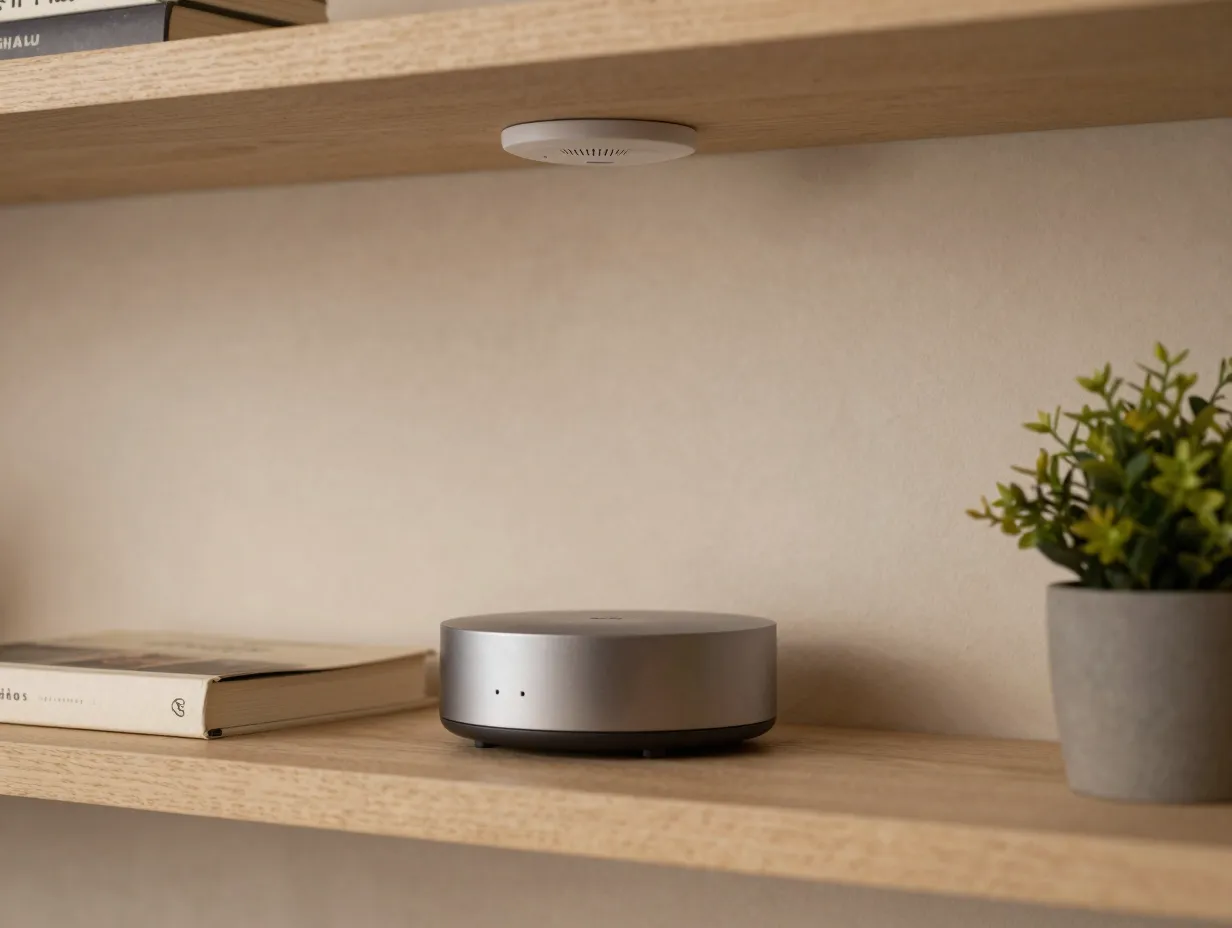
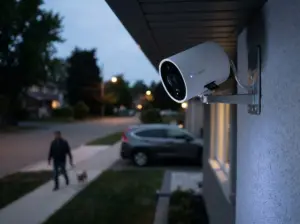
Smart hubs and sensors are the nervous system of an automated home, and they are also among the most visually disruptive elements if chosen without aesthetic consideration. A white plastic hub sitting on a bookshelf or a blinking motion sensor mounted on a wall corner communicates “gadget,” not “design” [6].
The market now offers alternatives that take form as seriously as function:
- Architectural motion sensors in round or square profiles that sit flush with ceilings, available in white, black, and custom-painted finishes.
- Smart hubs with premium enclosures in aluminum, fabric-wrapped speakers, and compact footprints designed to sit on surfaces without visual apology.
- Environmental sensors (temperature, humidity, air quality) in minimal disc or tile formats that read as design objects rather than technology.
When specifying sensors and hubs, apply the same criteria used for any decorative object: scale, finish, proportion, and placement. A sensor that blends into the ceiling plane or sits comfortably on a shelf as a considered object contributes to the room rather than subtracting from it [10].
7. Plan Automation at the Layout Stage
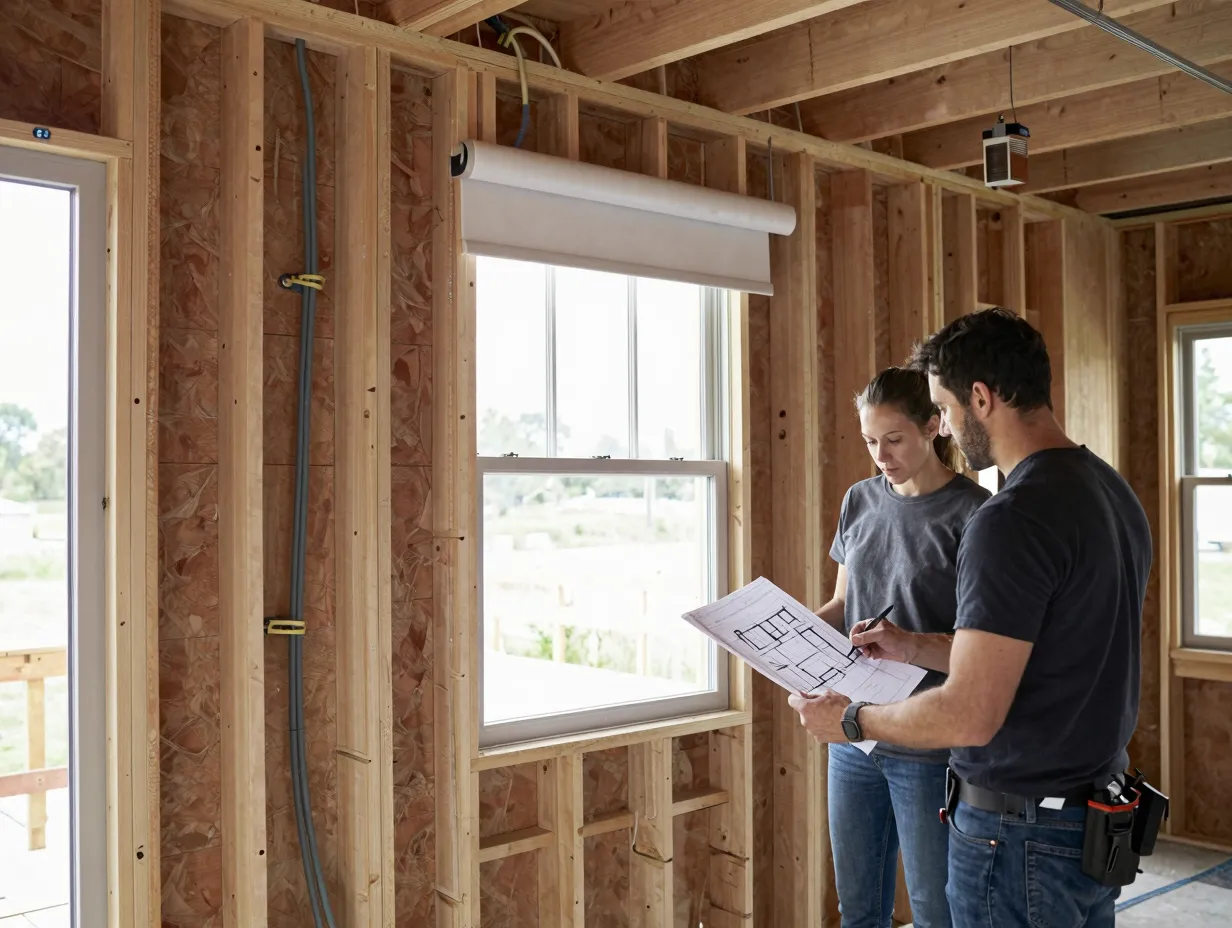
The single most impactful decision in smart home aesthetics is also the earliest one: integrating automation planning into the architectural and interior design process from the beginning, rather than retrofitting technology into a finished space [6].
When automation is planned at the layout stage, conduit can be run inside walls before they are closed. Equipment closets can be sized and positioned correctly. Ceiling recesses for motorized shades can be framed in. Low-voltage wiring for keypads and sensors can be routed invisibly. The result is a home where technology is structurally embedded rather than surface-applied.
Renovation and new build checklist:
- Engage a smart home integrator during the schematic design phase, alongside the architect and interior designer.
- Map every device location on the floor plan before walls are framed or finished.
- Specify conduit runs even for wireless devices, future-proofing requires physical infrastructure.
- Confirm equipment closet locations, ventilation requirements, and power provisions before construction begins.
For existing homes undergoing renovation, even a partial gut renovation offers the opportunity to embed infrastructure that would otherwise require surface-mounted raceways and visible wiring [2]. The aesthetic dividend of planning ahead is substantial.
8. Use Scene-Based Automation as an Aesthetic Tool
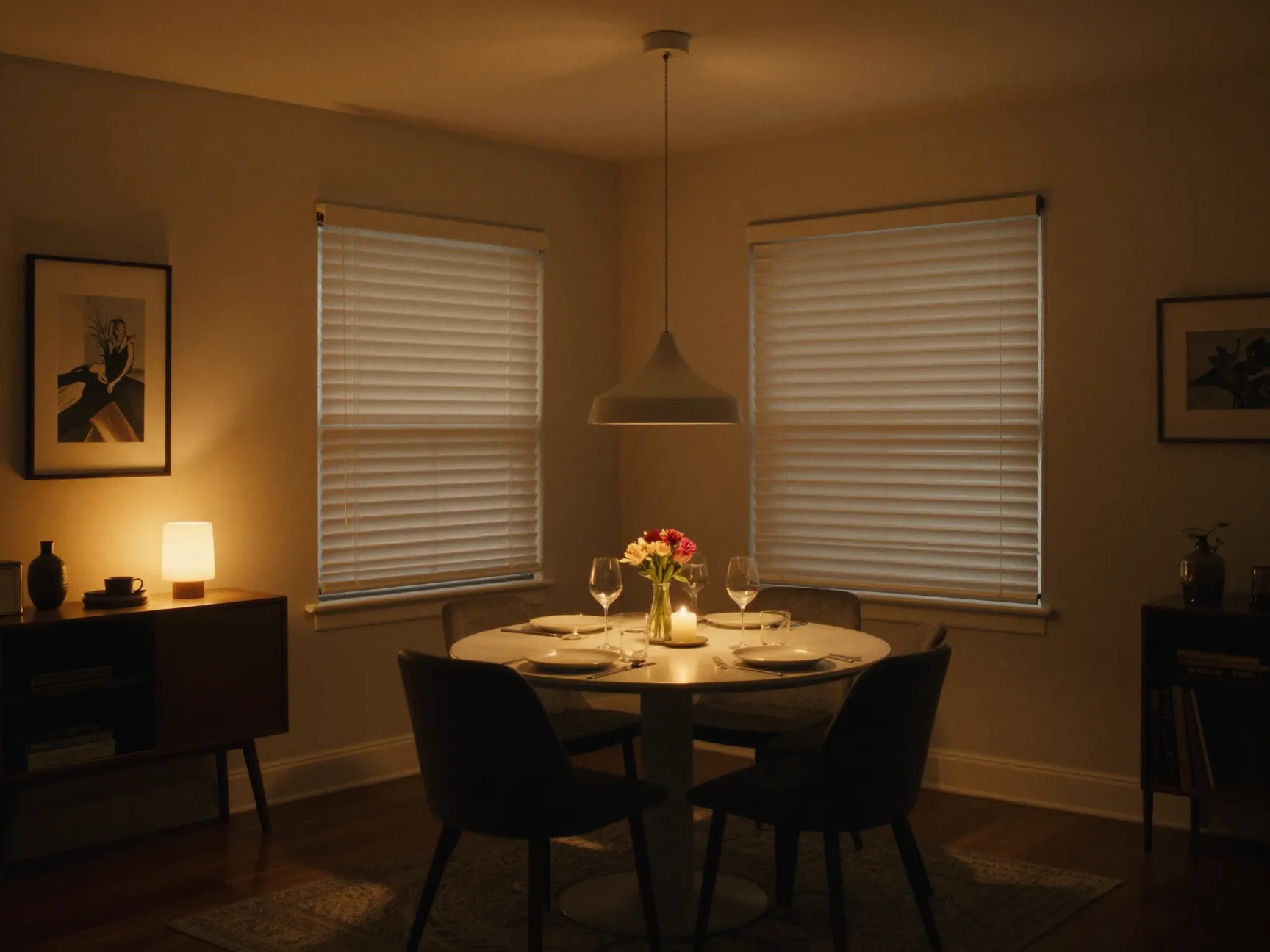
Scene-based automation is widely understood as a convenience feature, one button press to set lighting, shades, temperature, and music simultaneously. What is less widely understood is that scenes are also a powerful aesthetic instrument [4].
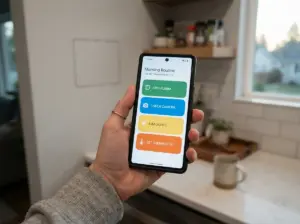
A well-designed scene does not just adjust settings. It transforms the visual character of a space. The “Morning” scene might raise shades to reveal natural light, bring tunable white lighting to 4500K, and activate the kitchen under-cabinet lights. The “Evening Entertain” scene might lower shades, shift lighting to 2700K with accent lights on artwork, and reduce brightness to 40 percent. Each scene is, in effect, a curated visual composition, a different version of the same room [7].
Scene design principles:
- Name scenes after activities or moods, not technical parameters (“Dinner” not “Lights 60%”).
- Design each scene as a complete visual composition, considering every light source, shade position, and architectural element.
- Test scenes at different times of day and in different seasons, natural light changes the effect of artificial lighting dramatically.
- Limit the number of active scenes to five or six per room to maintain clarity and ease of use.
When scene-based automation is framed as an aesthetic tool, a way of curating the visual experience of a home across the day, it becomes one of the most compelling arguments for smart home investment [5].
Coordinating Materials and Finishes Across Devices
One of the most overlooked aspects of the Smart Home Aesthetic: 8 Ways to Make Your Automation Beautiful approach is finish coordination across the entire device ecosystem. A home might have switches from one brand, thermostats from another, and sensors from a third, each in a slightly different shade of white or a different surface texture. The cumulative effect is visual fragmentation.
The solution is to treat the smart home device palette the same way an interior designer treats a material palette:
- Select a primary finish (matte white, brushed nickel, matte black) and apply it consistently across all visible devices.
- Where multiple brands are necessary, choose products whose enclosures can be custom-painted or replaced with third-party faceplates.
- Use a single design language, minimalist, industrial, warm-traditional, as a filter for every purchasing decision.
High-end projects increasingly specify custom-fabricated device enclosures that match wall finishes exactly, making switches and sensors virtually disappear into the surface [8]. At more accessible price points, finish-matched product lines from brands such as Lutron, Leviton, and Josh.ai offer meaningful coordination without custom fabrication.
Common Mistakes That Undermine Smart Home Aesthetics
Even well-intentioned smart home installations frequently fall short of their aesthetic potential. The following errors are the most common, and the most avoidable:
- Visible cable runs between devices and power sources, particularly on painted walls or finished surfaces.
- Mismatched finishes across switches, sensors, and hubs in the same room or adjacent spaces.
- Oversized control surfaces, large touchscreens mounted on walls where a slim keypad or voice control would suffice.
- Blinking indicator lights on hubs, routers, and sensors that create visual noise, particularly in bedrooms.
- Unplanned equipment placement, routers on bookshelves, hubs on kitchen counters, sensors on furniture surfaces rather than integrated into architecture.
Each of these mistakes has a straightforward correction. The common thread is treating every visible device as a design decision rather than a purely functional one [10].
Conclusion
The transformation of smart home technology from a gadget-driven category into a design-first discipline is one of the most significant shifts in residential interiors in 2026. The Smart Home Aesthetic: 8 Ways to Make Your Automation Beautiful framework, built on invisible tech, finish-matched hardware, tunable lighting, integrated shades, minimized control surfaces, aesthetically considered hubs and sensors, early-stage planning, and scene-based curation, gives homeowners and designers a clear, actionable path to automation that enhances rather than disrupts the spaces it serves.
Actionable next steps:
- Audit every visible smart device in the home and identify which can be concealed, relocated, or replaced with a finish-matched alternative.
- Consult a smart home integrator before the next renovation begins, even if the renovation is minor.
- Commission a lighting design that specifies tunable white sources, layered fixture types, and programmed scenes for each room.
- Select motorized shades in materials that coordinate with existing soft furnishings and specify recessed pockets where possible.
- Define a single finish language for all visible devices and apply it consistently across every room.
The home that looks effortlessly beautiful, where technology serves the space without announcing itself, is no longer a luxury reserved for high-budget projects. It is the result of deliberate, design-first decision-making applied at every stage of the smart home process.
References
[1] Smart Home Automation Ideas – https://hauteliving.com/designnetwork/smart-home-automation-ideas/
[2] Make 2026 The Year Your Home Finally Feels Intelligent – https://hteny.com/blog/make-2026-the-year-your-home-finally-feels-intelligent
[3] Smart Home Aesthetics The Art Of Integrating Smart Technology Into Interior Design – https://www.zeysey.com/public/en/lighting-automation/blog/detail/smart-home-aesthetics-the-art-of-integrating-smart-technology-into-interior-design
[4] A Complete Guide To Designing Smart Home Automations And Scenes In 2026 – https://illuslighting.com/en/blogs/posts/a-complete-guide-to-designing-smart-home-automations-and-scenes-in-2026
[5] Smart Home Aesthetics The Art Of Integrating Smart Technology Into Interior Design – https://www.zeysey.com/en/smart-home-automation/blog/detail/smart-home-aesthetics-the-art-of-integrating-smart-technology-into-interior-design
[6] Tech Meets Taste How Smart Homes Are Shaping Interior Aesthetics By Milind Pai Architects – https://www.milindpai.com/tech-meets-taste-how-smart-homes-are-shaping-interior-aesthetics-by-milind-pai-architects
[7] 78 Home Automation Ideas – https://www.control4.com/blog/78-home-automation-ideas
[8] Smart Home Iot Expo 2026 2nd Edition Of The International Trade Fair For Interior And Residential Building Automation – https://warsawexpo.eu/en/smart-home-iot-expo-2026-2nd-edition-of-the-international-trade-fair-for-interior-and-residential-building-automation/
[9] Smart Home Aesthetics The Art Of Integrating Smart Technology Into Interior Design – https://www.zeysey.com/en/minimalist-smart-home/blog/detail/smart-home-aesthetics-the-art-of-integrating-smart-technology-into-interior-design
[10] Smart Home Design Trends – https://www.re-design.app/articles/smart-home-design-trends